All Activity
- Past hour
-

Winter Meetings Dec. Trades FA Signings Thread
Bob Sacamano replied to caulfield12's topic in Pale Hose Talk
Any chance this guy signs for a lot less than was projected? Might be a good opportunity to get involved in. -
The possibility exists that he falls flat on his face in Spring Training and the Phillies want to make a Sprint Training deal
-

Winter Meetings Dec. Trades FA Signings Thread
Autumn Dreamin replied to caulfield12's topic in Pale Hose Talk
-

Winter Meetings Dec. Trades FA Signings Thread
WhiteSox2023 replied to caulfield12's topic in Pale Hose Talk
Unfortunately, Getzie is still sitting at the kiddie table on this one. 😉 I think I’d rather see what our own arms can do than give this guy $5.5+ million anyways. - Today
-
Stats.
-
.thumb.jpg.acbdc1097283affff104fdb503e5766f.jpg)
Winter Meetings Dec. Trades FA Signings Thread
WestEddy replied to caulfield12's topic in Pale Hose Talk
-
NFL teams with great coaches are the only ones who are successful, and coaches are not subject to the salary cap. Stud QBs have never been bought by the highest bidder. They've always been zealously guarded by whoever drafted/originally signed them, to the point where a big part of the NFL's stance against free agency until relatively recently was due to "protecting" QBs from poaching. NFL team spending has always been in a rough parity as well. There's just not a lot to indicate that the salary cap has been the driving force in any change to the competitive landscape there. OKC is not a dynasty yet, and this is really their first glimpse of sustained success in franchise history, even going back to the Seattle days. If we're talking NBA market size, four of the seven dynasties (Lakers, Bulls, Warriors, Celtics) since the cap started are large markets and account for 66.7% of dynasty championships and 55% of overall championships. I don't see how four teams accounting for 55% of championships in the last 40 years shows a salary cap win. I've also already outlined why I think a cap and floor won't work in MLB in a previous post, but it really breaks down to A) The cap isn't going to be below the current highest spend, B) The high spenders will still spend the most, and C) Floors are only going to enforce bad decisions from the poorly run teams at the bottom, and you can't force them to pay more than they are able to. A better revenue sharing model and standardized TV rights are much better ideas.
-
Confirmed by Dombrowski today…
-
Anyone but the Mets and utility man Acuna please.
-
And the true solution might just be trading with the Royals or Guardians. Robert won't be a fixture in either place. He either gets bought out at the end of 26 or 27. Then he hits the market and takes top dollar available.
-
But it does align with this source. I wouldn’t trade for $20 million dollar Robert if I had Crawford waiting in the wings either.
-
Yeah, I blew that one. I don't know what I was looking at last night.
-
It’s Boob so anything can happen
-
I don't follow hockey except to bandwagon the Hawks, and I don't follow the NBA that closely because the Bulls are a dumpster fire, but enough to keep track of the league. I do follow the NFL. I know the NFL has revenue sharing. If you want to argue that MLB needs a similar revenue sharing model (or at least a standardized TV deal), that's definitely worth considering. I just don't think a salary cap is going to accomplish anything. The A's were in the same market as the Giants and have had multiple dynasties and years of dominance. Their recent incompetence has little to do with their market size.
-
-
MLB to regulate MiLB data and sharing
southsider2k5 replied to southsider2k5's topic in Pale Hose Talk
Well that is something.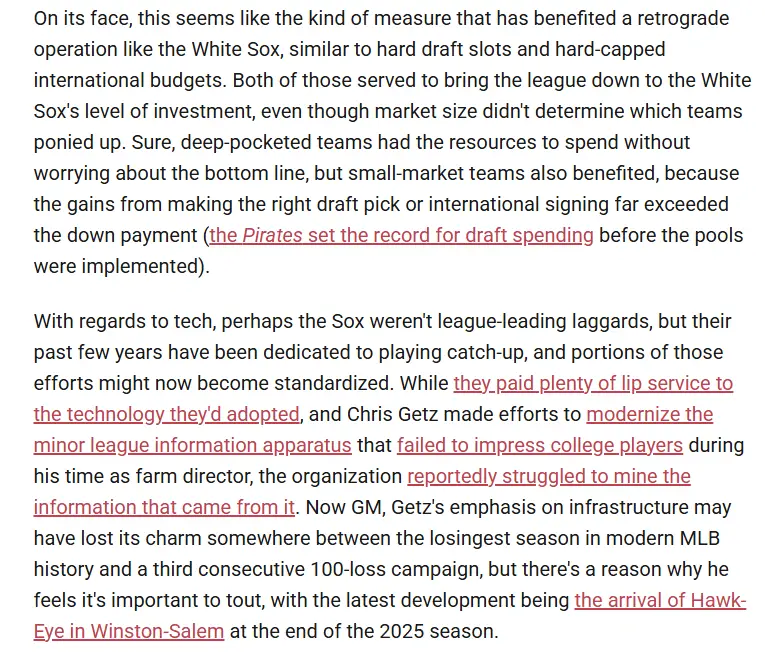
-
Sox Machine with a detailed look at this decision: https://soxmachine.com/2025/12/mlbs-data-regulation-could-be-a-shortcut-to-help-white-sox-finish-what-theyve-started
-

MLB to regulate MiLB data and sharing
Chicago White Sox replied to southsider2k5's topic in Pale Hose Talk
100% this. There are a couple of owners abusing the revenue sharing system, but there are many other small market teams that do everything right they can control but are subject to a massive difference in revenue vs. their large market peers. I find absurd to think those owners should have to fund massive losses year after year in order to compete with the big market clubs. There is a reason the other leagues all have better parity than MLB and that’s because they use a cap & floor to ensure the major market teams don’t have a massive competitive advantage. -
MLB to regulate MiLB data and sharing
Chicago White Sox replied to southsider2k5's topic in Pale Hose Talk
Now do this by market size. The NFL has without question the best parity in major sports. Yes, teams with stud QBs are going to be more successful (which is what the above highlights), but all teams regardless of market size have equal access to getting one. The NBA’s parity is also better than the MLB, but not as good as the NFL because large market teams (and Miami) do have some advantage in getting stars in free agency due to individual player caps. That being said, a small nothing market like OKC is able to form a dynasty because of the benefit of a salary cap. That simply is not possible in the MLB…TB is probably the best example of small market success and they have to battle every year and have never been able to get a World Series. -
Dallas/Ft. Worth is the 4th largest metro area in the US. 8.3M people vs. 9.4M in Chicago's metro. How are they mid market by any metric? https://en.wikipedia.org/wiki/Metropolitan_statistical_area
-

MLB to regulate MiLB data and sharing
Look at Ray Ray Run replied to southsider2k5's topic in Pale Hose Talk
Those markets aren't considered as small of a market from a competitive standpoint because the NFL does significant revenue sharing and has a salary cap to prevent market size from dictating the quality of team you can put on the field. Also, saying that caps don't matter in other sports when you literally watched the Chiefs have to move all their offensive talent, but for Kelce, to retain Mahomes just shows how pointless this conversation is. I've already wasted too much time here though, as you could present some here with the most indisputable evidence possible and they'll still dispute it. -
But that's the problem. In the NFL, Green Bay and KC can be powerhouses and nobody talks about them as small market teams. In MLB, it's gotten to the point where the only powerhouse franchises are in the top 12 or so markets. Everyone else has to either catch lightning in a bottle or keep tearing down and rebuilding like the Guardians and Rays do.
-
MLB to regulate MiLB data and sharing
Look at Ray Ray Run replied to southsider2k5's topic in Pale Hose Talk
The size of a market and it's influence doesn't change based on the sport. The NFL has significant revenue sharing. The MLB does not. The Dodgers make 3 times as much revenue as the A's. Meanwhile, the Cowboys are only making twice as much in revenue than the last ranked NFL team. The Chiefs were 18th in revenue during a dynasty run so not sure what you're pointing too. Again though, just you arguing argue. Didn't you say you don't even follow the NFL/NBA anymore? -
The markets are different in the NFL. You can't 1:1 compare them. Look at revenue by team for both leagues and compare where each team is ranked.
-
I disagree with this. Over the last 20 Super Bowl champs, here are the small market winners: Green Bay, Kansas City (x3), Tampa Bay, New Orleans, Pittsburgh. That's 7 times in 20 seasons. Plus 3 arguably "middle market" SB champs: Baltimore, Seattle, Denver. That's half the SB titles in the last 20 years that weren't in a top 12 market vs. only 4 out of 20 in MLB. If Kansas City and Tampa Bay are small markets in MLB, then they're small markets in other sports too. Green Bay/Milwaukee, too.